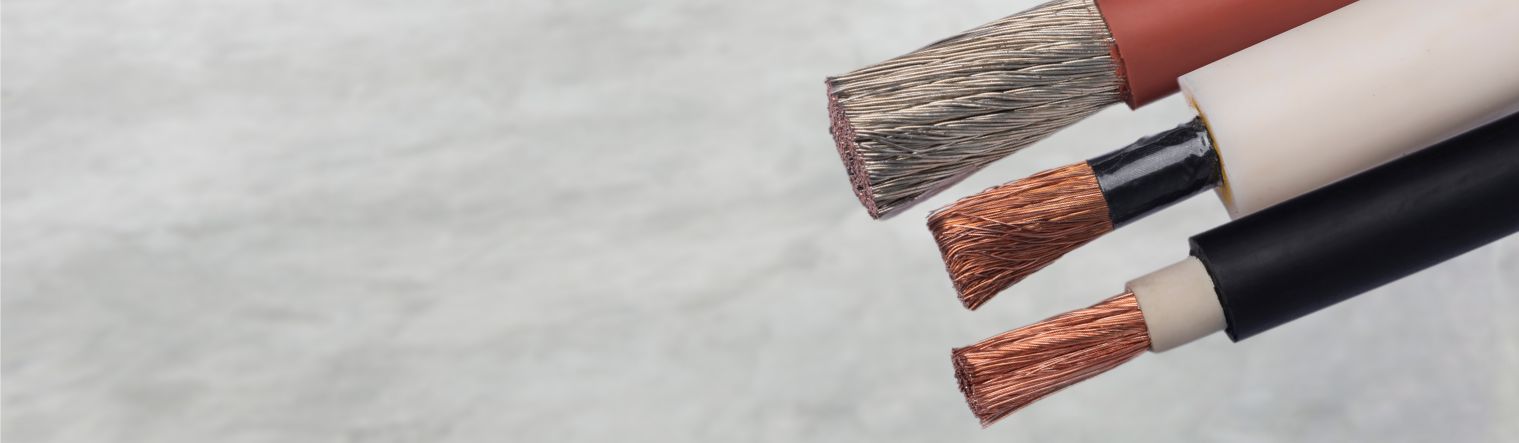
Solar photovoltaic cables are used for transmitting electrical power generated from the solar panel to the charging units, battery banks, change over systems, inverters etc. These cables have to function effectively while remaining exposed to a wide range of severe environmental conditions
| Construction | |||
| Size (Sq mm) |
Number of Strands / Diameter | Nominal Outer dia (mm) |
Max Conductor Resistance Ohms / km |
| 2.5 | 50/0.25 | 5.50 | 8.21 |
| 4.0 | 56/0.30 | 6.00 | 5.09 |
| 6.0 | 85/0.30 | 6.80 | 3.39 |
| 10.0 | 140/0.30 | 7.70 | 1.95 |
| 16.0 | 128/0.40 | 8.80 | 1.24 |
| Size(Sqmm) | Single cable in Air(Amps) |
Single cable on surface (Amps) |
Multiple Cable on Surface (Amps) |
| 2.5 | 41 | 39 | 33 |
| 4.0 | 55 | 52 | 44 |
| 6.0 | 70 | 67 | 57 |
| 10.0 | 98 | 93 | 79 |
| 16.0 | 132 | 125 | 107 |
| Voltage Grade | 1000 V AC / 1500 V DC |
| Temperature Range | – 40° C to 120° C |
| Conductor | Tin Coated Copper Class 5 conductor |
| Insulation and Sheath | Electron Beam Irradiated Cross linked Polyolefin Compound |
| Standards | TUV-2PIG 1169 / 07 2008 (Standard for Photovoltaic cables) or BSEN 50618-2014 (Covers upto 240 Sq. mm) |
| Features | Resistant to ozone, water absorption & severe environmental conditions |
Not sure where to start? Try our products
Our solution can find thermosystems products
REQUEST A CALL BACK